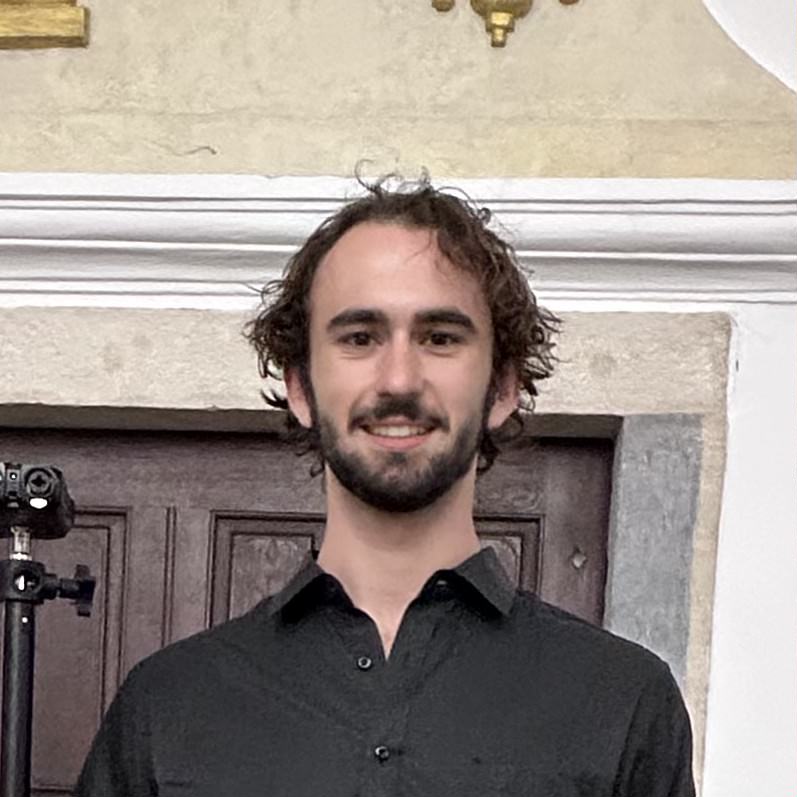
The recording below is an interview which took place outside the Church of Santa Mariña in Sarría, Galicia, Spain immediately following a performance of plainchant from the Codex Calixtinus, the Holy Book of Saint James which was written by Catholic monks in the 12th century for Pilgrims on the Camino de Santiago. The interviewees were all pilgrims themselves, having begun the journey at various locations on the trail, who I had befriended and sung for in some cases more than once. The interviewees were diverse in age, gender, religious background, and nationality.
In the interview, Bronwyn from Australia discusses her experience of the music through the lens of her yoga practice. In a conversation about divinity, she mentions something she calls sublimation, where the sound in the air and the ground is transmitted directly into her body and resonated as if she were a part of the building. But why is the body such an essential part of sacred music? The Camino made this clear to me in a big way:
I should not say that the pain I experienced on the Camino de Santiago was a surprise. I read about the journey for many months before undertaking it, though I couldn’t have possibly imagined what 15 miles a day would really feel like. I knew pain was inevitable, but I did not know how my body would handle it. My body was the most surprising part of the journey by far. After the first day trekking over a mountain between Pamplona and Puente la Reina, I lied out in the hostel yard, stretching, writhing, groaning through what seemed to be total musculoskeletal exhaustion. In that moment, I recall wondering how I was ever supposed to make it through a whole month of walking while conducting this project at the same time. Little did I know how much more pain I had in store.
I walked wrong, I carried my backpack wrong, and it was my own fault. The backpack I purchased from REI was sort of a two-in-one, which was appropriate for the load I was bearing. I had a bigger, duffel-sized backpack for all my clothes and toiletries that I strapped into like a jetpack, and a smaller daypack where I kept my laptop, Zoom HD recorder, and my binder full of chants which I carried in front on my chest. I also kept my drinking bladder in the daypack for easier sipping access, so I’m very thankful it stayed watertight. From Pamplona, all the way to Burgos, about 200km, I carried this hefty gear without using a key set of straps which would yoke the larger backpack up to put more weight on my shoulders than on my lower back. I was bearing a 40-pound load almost entirely on my lumbar. This mistake manifested in joint pain and soreness in my hips, knees, and ankles, unlike that which I had ever known.
By the time I arrived in Burgos, I was practically wincing at every step. My roommate and travel companion began to make it miles further than I could in the same amount of time because I moved so much slower. My right ankle was weak and overused, and on my left side I could feel my hip pushing down into my leg socket. My gait was turbulent. My muscles were no longer using the proper form to walk, molded rigidly into the awkward position it took for my body to bear the load I had on me. Luckily, we had one day of rest budgeted in Burgos, to recover and see a bit of the city. When we arrived in Burgos on Tuesday night, we found the massage parlor “Ultreia,” named for a Pilgrim’s greeting and specializing in healing Pilgrims’ pains. We both made an appointment for Wednesday at noon.
Wednesday’s appointment taught me a lot about my body. My massage therapist, Sara, began by asking me about my pains and my experience so far on the Camino. After needing a reminder of the Spanish word for “hip” (la cadera) I told her about the sharp pain in my left side and the dull pain in my right ankle. After a lengthy foot massage and a mere glance at my back, she had me sit up so I could look at a diagram of the skeletal system. She told me that in these kinds of pictures, the body is always straight and symmetrical to show that the mechanics are the same on both sides. However, real bodies rarely look this way. Owing to the the experiences our bodies process, people’s spines, ribcages, pelvises, and limbs often fall out of balance, leaving us with leans, hunches, and curves. She told me she could clearly see the way I was walking favored the right side to lead and the left side to drag the weight of my pack. This was causing the pain in my right ankle, the ox that was overextending itself to pull me forward, as well as in my right hip, the pack mule bearing most of the load.
She said carrying and walking were two things I had to do at the same time, and I couldn’t simply expect the momentum of my walking to carry my 40 pounds all by itself. I would have to consciously recalibrate my body so my arms and back could work independently from my legs, and she showed me just how. My whole left leg, which tends to open out to the left side, must come around to face forward and align my hip with the rest of my body; this keeps my ribcage from slumping down into my pelvis and keeps my left shoulder up. Simultaneously, my right arm must come down and back in order to open up the right side of my back to bearing weight, which also takes extra tension off my chest. She gave me a special stretch for this: laying flat on my stomach, without raising my head, I should raise both my right arm and left leg at once (and vice-versa) to equal heights — I should be careful that they are equal – and stretch my frame outward in all directions. I have done this stretch every single morning since that day. Further down the road, my body began to change significantly.
Coming out of Burgos, I never again experienced pain like I had coming in. I unpacked everything to do laundry on our day off from walking, which is when I discovered the straps that would help me lift the weight off my hips onto my shoulders. This proved essential to the reconfiguration of my walking form, because I could make the strap tighter on my right shoulder to compensate for the lean to which my body was inclined. Even at the end of the Camino, when we walked 13 days in a row without a day of rest, I could manage my shin splints with gratitude that I felt them equally in both legs.
The reason the effects of the Camino upon my body became so significant to me is because I felt it in my singing. My body is my instrument. As a vocalist, I have had a lot of trouble breathing deeply and connecting the abs and diaphragm to the centers of resonance in my chest in head – just ask my voice teacher! My tendency to fall flat and run out of breath is directly correlated to how my body takes air. With my left side collapsed in on me and my right side overcompensating, I can’t properly fuel the voice any better than I can carry two packs across the Iberian peninsula. Trying to force out resonant sounds without proper breath support strains the voice, and a good singer floats freely on well-supported air. If I am not focused on proper form, whether walking or singing, I will misuse my body and leave myself damaged. I have had much more success as a singer since learning a few of these key things about my body and recently began to access parts of my head voice that had not been possible without the extra breath support. This came to be the biggest surprise to me on the Camino: dedicating time and energy to good from the onset of a practice is always worth it to prevent pain and mistakes down the line. It all starts in the body.
We live in a society all too ashamed of its bodies. Bodies are grouped into categories by genitalia and expected to perform in a certain way because of imposed structures. I insist, we are so much more than this. It should come as no surprise that performers are a notoriously gender nonconforming guild of workers. As singers, we are strikingly aware of the possibilities represented by our bodies. A beautiful singer is an icon, a glimmer of hope, a breathing blessing, and yet totally human. There is no reason that roles of gender, ability, class, or race should be enforced upon a body capable of so much more without them. The same is true for all artists, who engage also in the evocation of emotion using their bodies. Divinity for the human is accessed through the body. The body is evoked through the arts, which resonate physically and carnally, and change the very fiber of our being.
This transfiguration is the same one at the heart of Christian religious doctrine wherein lies the ethical mythology of Western civilization. The divinity is there in the body. Yet we, as singers, the creators of the art ourselves, are unmistakably human. In this performance, the musician is caught somewhere halfway between. The role of the Catholic Church in the life of the singer was to harness them for many years as gifted servants to God, employing many but keeping the political power of their art at bay. Conversely, the role of massive record labels in the United States has been to harness singers for their godliness, for the icon they create, employing few who receive unimaginable influence in the name of their own personal artistry. We have seen this power used for good and for evil, but in any case, the power of the singer lies in their ability to create a feeling somebody did not have before. We know that this power exists; it is our job to use it responsibly.
 Luke Stowell
Leave a comment